
Your Work In Progress (WIP) Report Is a History Book
And it's costing you double digit losses on your margins

The automation industry discovered margin fade decades after construction did. Here is what to do about it.
I ran my shop for years without a real profit fade alert. We had a job cost report. It was a good-looking report. It had columns, colors, a drill-down, a little chart if you wanted it. Every Friday I would open it, scan the numbers, decide things looked fine or not, and close my laptop. The problem was that “fine” was measured against the wrong number. I was comparing actuals to budget, not actuals to original bid margin, and I did not have a single threshold configured to flag the gap between those two things. So when a job finished at 8% instead of 22%, I found out at final acceptance. Not at the midpoint billing. Not when the schedule slipped. At final acceptance, when the margin was already locked in, the customer had already signed off, and there was precisely nothing left to do but stare at the number and think about what I would have done differently if I had seen it six weeks earlier.
The answer, it turns out, is a lot.
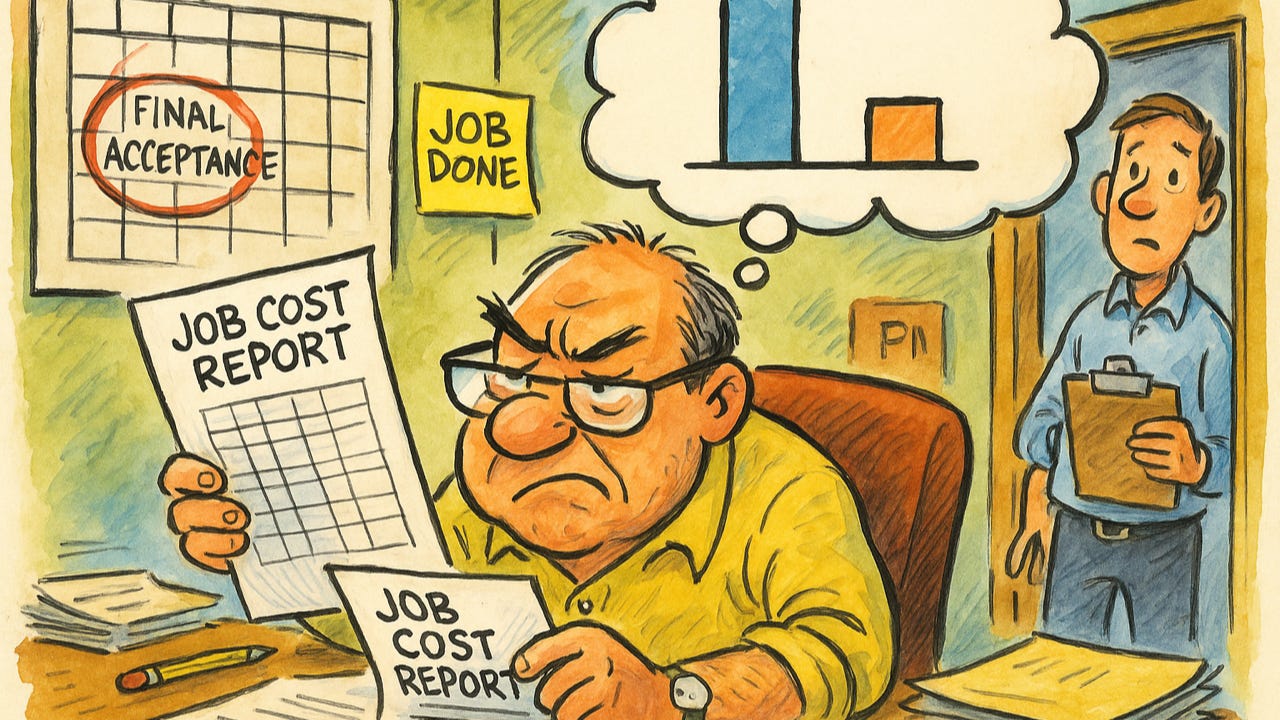
Construction Solved This Years Ago
The construction industry built profit fade monitoring into its financial infrastructure more than 30 years ago. They did not do it out of discipline or particular financial sophistication. Their bonding underwriters required it. Surety companies started watching WIP (Work in Progress) reports as part of the bonding process, and once they did, the industry had to build the reporting muscle to support it. The rule that emerged from that pressure: underwriters get nervous when underbilling exceeds 20 to 25% of working capital. They want to see jobs tracked not just by actuals versus budget, but by current projected margin versus original bid margin. The gap between those two lines is called profit fade, and construction figured out how to surface it mid-job while there was still time to do something about it.
An automation integrator is, essentially, a construction company that uses metal and tech vs concete and wood. Custom machines, engineered-to-order systems, multi-phase integration projects with progress billing tied to milestones, labor-intensive scopes, and final acceptance events that determine whether you get paid the last 10%. The economics are nearly identical.
So construction has had this for 20 years. Many of you are discovering it now. That is not a knock, it is just the timeline. The question is what you do next.
Four Failure Modes: All Running at the Same Time
I paid for not having this. All four failure modes were running simultaneously in my shop, and they compound.
The report is configured to show history, not alerts. A job cost report is, by default, a rearview mirror. It tells you what happened. It does not tell you that the current trajectory, extrapolated forward, will produce a margin X points below what you bid. By default, most shop management systems and even most ERPs will show you actuals versus budget. They will not automatically compare current projected final margin against original bid margin unless someone sets that up. Nobody sets that up. I did not set it up for years.
Closeout has become the review meeting. There is a cultural habit in project-based shops where the job cost report gets a serious look at project close, sometimes during the billing dispute, and almost never at the midpoint. The mentality is that the job is not done, so the numbers are not final, so there is nothing to act on yet. This is exactly backwards. The midpoint is precisely when there is still something to act on: you can renegotiate a change order, recover a scope bleed, have a hard conversation with a customer, or at minimum stop throwing more hours at a situation you now know will not recover. By closeout, those options are gone.
Billing is tied to customer acceptance events. Most automation shops bill against customer-controlled milestones: FATs, SATs, final commissioning sign-off. This means your billing trigger, and with it your cash event, is something the customer controls. The practical effect is that a job can be burning for weeks while the billing stays locked behind a milestone that has not cleared. You do not have a shop-controlled deliverable that forces the financial conversation mid-job. Construction figured this out and moved toward billing their own deliverables wherever possible, not waiting for the customer to declare the phase complete.
The thresholds are absent or set so loose they fire after the damage is done. Some shops do have an alert. It fires when margin drops X points from bid. That is not an early-warning system. A 20-point margin drop on a job that bid at 22% means you are at 2%. The alert has arrived, but so has the loss.
What I Eventually DId
The fix is not complicated, and it does not require new software. It requires configuring what you probably already have.
Weekly (yes weekly) compare estimated versus actual hours and materials. Not just actuals versus budget. Actual costs incurred against the original estimated costs at that phase, carrying forward the implied final cost trajectory. From that comparison, calculate where the projected final margin lands relative to the original bid margin. If that gap is more than 5 points, the alert fires and routes to the owner and the project manager (PM).
5 points is the right threshold for automation work. It is tight enough to catch the job while there is still a phase to act in. It is not so tight that a normal week of schedule variance triggers a panic. Research from ReportingGuru’s WIP reporting analysis puts the basic profit fade monitoring threshold at a 5% margin drop for safety purposes.
The alert routes to two people: the owner and the PM. Both, at the same time. Not the PM first, not the owner first. Both, simultaneously.
I want to say something about the PM here, and this is where the cultural piece lands. The PM on a burning job almost always knows the job is burning. They know before the report knows, before the billing milestone, before anyone asks. They see the hours. They are on the floor. They watch the schedule slip and the extra engineering requests pile up. And most of the time, they say nothing. Surfacing bad news in a project-based shop is politically uncomfortable. The owner does not want to hear it. The PM does not want to be the one to deliver it. So the job burns in silence while both parties hope it gets better. It almost never gets better. The alert bypasses that situation. It makes the conversation mandatory before the loss is locked.
Always Compare Against the BId
I read my job cost report every Friday. I was conscientious about it. I was running a real shop with real jobs and real numbers, and I looked at them regularly. What I was not doing was running a comparison between current projected margin and original bid margin in the same view. They were in different places. The job cost report showed me actuals. The original quote was in a different system, sometimes a spreadsheet, sometimes a file in a folder, rarely something that could be pulled automatically into the same row as my Friday report.
This is not a technology failure. It is a configuration failure that I let persist for years. The report looked complete. It had the numbers I was used to looking at. Adding a “bid margin” column and a “current projected margin” column and the delta between them was half a day of work. I did not do it for years. The reason is that when a report looks functional, it is very easy to believe it is complete. The job cost report was not complete.
The CPR (Cost Projection Report) You Need
Here is the concrete version, written down so there is no ambiguity.
Each week (yes each week), pull total labor hours estimated vs. total labor hours incurred to date, plus material costs estimated vs. incurred. Extrapolate the remaining phases using actual burn rates, not original estimates. Look at open POs and AP that has not hit the project yet.
Calculate projected final margin from that extrapolated cost at completion.
Compare projected final margin to original bid margin.
If the gap is more than 5 points, fire the alert. Route it to the owner and the PM. An email or a message that lands in front of two people who have to respond to it.
Review at the next owner-PM touchpoint, not at the closeout meeting.
The thing that makes this work is the shop-controlled trigger. You are not waiting for the customer to accept a phase. You are running the comparison weekly, which is a date or an internal deliverable that you control. The customer’s acceptance event may come later. Your financial snapshot comes first.
A/E firms, which have the same project economics as automation integrators, ran a benchmark in 2026 that found the industry “flying blind on the numbers that decide whether the work pays off” despite reporting tools being widely available. The tools are not the problem. Configuration and culture are the problem. This is the same conclusion I would have drawn from my own shop, just expressed more politely.
If you do not have a forward looking CPR you are flying blind!
What You Are Actually Building
You are not building a dashboard. You are building a prediction tool.
The alert exists to make the owner-PM review happen before the loss is locked, not after. That is its entire purpose. The threshold is set so that when the alert fires, there is still a phase of work remaining where a decision could change the outcome.
The shops that have this run better jobs. Not that they are smarter, not that they estimate better, not that their customers are easier. They run better jobs and the reason is simple: they see the problem while there is still time to make a different decision. The shops that do not have this run jobs that look fine every Friday, right up until they finish at 8% instead of 35%.
The Automation Navigator is written by Sean Dotson PE, founder of Automation AMA. Over 20 years, Sean built RND Automation from the ground up into a successful industrial automation company and ultimately through a private equity exit.
Today, he works with manufacturers and business owners who need an experienced sounding board, a second set of eyes, or hands-on help improving and changing their business.
That may include operations, growth, technology, leadership, sales, acquisitions, or preparing for an eventual exit. The focus is practical: identify what is holding the business back, challenge assumptions, and turn ideas into measurable results.
Learn more at www.automationAMA.com or reach out directly.

Sean, great article. Job cost reports that only show history, not the delta between original bid margin and current projected margin, are one of the most common blind spots I see in manufacturing businesses.
I feel so strongly about this that as an M&A advisor, I’ve gone back to school to get my Masters of Accounting/Finance.
One thing I’d add on the front end. This discipline has to start at the bid. Too many shops price jobs using variable costs alone, labor and materials, and either skip or under allocate fixed overhead. If your bid doesn’t build in a real allocation of fixed costs, you’re baking margin fade in before the job even starts. The 5 point alert you’re describing is a great mid job catch, but it can only catch fade against a bid that was priced right in the first place.